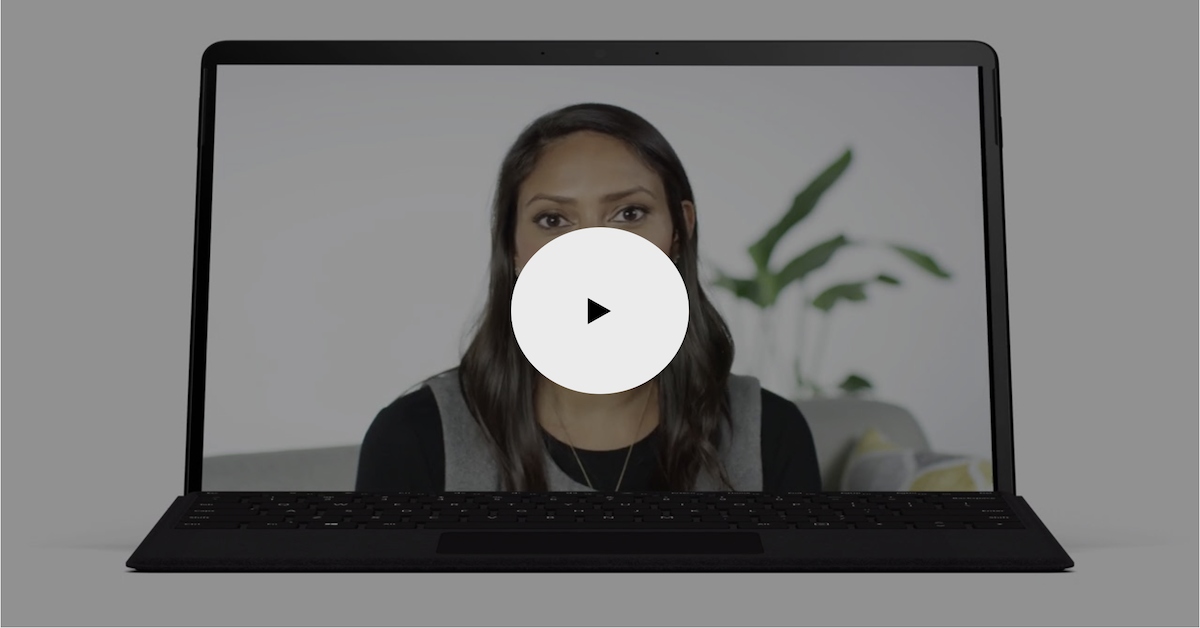
This blog post features an interview with Stevie Bathiche, a Microsoft Technical Fellow and one of the engineers behind the unique Eye Contact technology that allows users to meet each other's gaze as if they were in the same room, helping establish rapport and trust, and enabling greater inclusiveness across demographics. Please contact Coretechs for more information about the new Eye Contact technology.
What is Eye Contact on Surface Pro X?
Eye Contact is an AI-powered feature available on **Surface Pro X** that subtly adjusts your gaze on video so you appear to be looking directly into the camera.
Using the **onboard Neural Network accelerator** in the custom **Microsoft SQ1 chipset** and the **5.0 MP front-facing camera** (which supports **1080p full HD video**), Eye Contact analyzes your face in real time and repositions your gaze by just a few pixels. This helps conversations feel more natural, as if you were in the same room.
You can turn Eye Contact on or off in the **Surface app**. Once enabled, it works automatically across:
• Video calling apps like **Microsoft Teams**, **Skype**, and others
• Video recording scenarios, such as creating content or presentations
The feature is designed as a **camera-level capability** (similar to focus or brightness), so it doesn’t require any changes from app developers and remains under your control as an **opt-in** experience.
How does Eye Contact improve communication and user experience?
Eye Contact is built around how people naturally communicate. Social science shows that when two people talk, they tend to focus on each other’s faces, and **eye contact plays a key role in trust and mutual understanding**.
On typical devices, the camera is offset from where you look on the screen, so when you focus on the other person’s face, it can appear as if you’re not paying attention. Eye Contact helps **reimagine** that experience by aligning your gaze with the camera, so your micro‑expressions and intent come through more clearly.
This can be especially helpful for:
• **Remote work and meetings** – making it easier to build rapport and read intent
• **Online learning** – helping students and teachers feel more engaged
• **Virtual health and legal consultations** – where trust and clear communication matter
• **Children and less camera‑confident users** – who may find it hard to remember to look at the lens
Because the feature runs on the dedicated AI silicon, it is designed to be **power efficient**, so you can use it for **multiple hours of calls and recordings** without a noticeable impact on battery life. The team also focused on preserving your **identity and natural expression**, adjusting only what’s needed to support more authentic connection.
What technology powers Eye Contact and what’s next for this AI capability?
Eye Contact is enabled by a combination of hardware and software designed to **reshape** how AI runs on personal devices:
• **Microsoft SQ1 chipset** – A custom processor in Surface Pro X that integrates a dedicated **AI chip** for **AI offload**.
• **Onboard Neural Network accelerator** – Handles the real-time gaze adjustment without overloading the main CPU.
• **Camera integration** – Eye Contact is built directly into the **camera pipeline**, just like focus or brightness, so any app that uses the camera can benefit without extra development work.
This architecture makes Surface Pro X the **first Windows PC to fully offload AI onto a specialized chip**, enabling advanced features like Eye Contact while maintaining **thin and light design, strong battery life, and fast charging**.
Looking ahead, Microsoft expects a **variety of AI experiences** to be infused across the Surface product line. Which features appear on which devices will depend on:
• The device’s **AI acceleration capabilities**
• The maturity of the **AI software platform**
• Evolving **customer needs**
Eye Contact is one example of how **AI at the edge** can help reimagine everyday experiences—from the application layer in Windows down to the silicon—so devices can help people connect more effectively while staying portable and power efficient.




 Sign in with LinkedIn